October 28, 2026
How Build-to-Suit Development Supports Multi-Location Expansion
Published in
Insights
•
3
minute read
Share this Post:
Share this Case Study:
Opportunity
Services Provided
Results
For growing brands, expanding into new markets creates an opportunity to build a real estate strategy that can scale alongside the business. As the footprint grows, the real estate process must become increasingly repeatable, with clear standards for where to locate, what to build, how projects are managed, and how each new facility supports the broader business strategy.
Build-to-suit (BTS) development can provide that structure. Rather than adapting existing spaces to fit the needs of each new market, brands can work with a development partner to identify strategic sites and deliver purpose-built facilities around a consistent prototype, operating model, and expansion plan. For companies pursuing multi-location growth, this approach can create a more scalable path from one successful location to the next.
Why Is Build-to-Suit Development Well Suited for Multi-Location Growth?
Build-to-suit development is a model in which a developer identifies or acquires a site, manages the development process, and delivers a facility designed specifically for the tenant under a long-term lease.
For a brand opening multiple locations, the value of that model extends beyond any single property. A repeatable development approach can help establish consistency across markets while giving the tenant a partner to manage many of the real estate responsibilities associated with expansion. This can be particularly valuable for brands with defined prototypes, specific site criteria, or plans to enter several markets over time.
Here are five reasons build-to-suit development can be especially effective for multi-location expansion.
1. Create a Repeatable Real Estate Expansion Process
Multi-location expansion becomes increasingly complex as the number of projects for a brand grows. Each new location may require site sourcing, market analysis, negotiations, due diligence, entitlements, design coordination, permitting, construction, and project delivery.
A build-to-suit development partner can manage these components through a consistent process from one project to the next. Instead of rebuilding the real estate strategy for every new location, the tenant and developer can establish criteria, workflows, and expectations that become more refined with each project. Over time, this repeatable approach can make it easier to evaluate opportunities, identify potential challenges, and move qualified sites through the development process more efficiently.
2. Apply Consistent Site Selection Criteria Across Markets
As brands enter new markets, each potential location needs to be evaluated against a consistent set of criteria that reflects the tenant’s customer base, operating model, and broader expansion strategy.
Build-to-suit site selection can incorporate factors such as:
- Population and population growth
- Household income and other demographic characteristics
- Traffic counts, visibility, and access
- Competitive activity and market gaps
- Proximity to existing locations
- Drive-time demographics and trade areas
- Zoning and development feasibility
- Site economics and infrastructure
- Compatibility with the tenant’s prototype
Using a defined framework across multiple markets can help brands compare opportunities more consistently and focus resources on sites that best support their expansion strategy. It can also help reduce unnecessary cannibalization by considering how each proposed location fits within the tenant’s existing network.
3. Maintain Greater Consistency Across Locations
For many multi-location brands, consistency is a critical part of both the customer experience and the operating model. Build-to-suit development allows each facility to be designed around the tenant’s established prototype rather than requiring the business to adapt its operations to the limitations of an existing property.
That prototype may address elements such as:
- Building layout
- Customer flow
- Parking and circulation
- Signage and branding
- Equipment requirements
- Back-of-house operations
- Employee workflows
- Site-specific operational needs
While each property may require adjustments based on the market, parcel, or local requirements, the core facility can remain consistent from one development to the next. This can simplify operations while helping ensure that new locations reflect the standards customers and employees have come to expect from the brand.
4. Preserve Capital for Business Growth
Expansion requires capital beyond the real estate itself, particularly as a brand begins opening multiple locations. New facilities may require additional hiring, inventory, equipment, technology, marketing, and other operating investments.
In a typical build-to-suit structure, the developer funds and owns the real estate while the tenant occupies the completed facility under a long-term lease. This can reduce the need for the tenant to commit significant capital to land acquisition and construction, allowing more resources to remain available for the operating side of the business. For a brand pursuing a broader rollout, that capital efficiency can become increasingly meaningful as the number of new locations grows.
5. Reduce the Internal Burden of Development
Commercial development requires coordination across numerous disciplines, and that complexity can grow quickly when projects span multiple markets or jurisdictions. Local zoning requirements, permitting processes, utilities, consultants, contractors, and construction conditions may vary considerably from one location to the next.
Working with an experienced build-to-suit developer allows the tenant to rely on a dedicated real estate team to manage these responsibilities while internal leadership remains focused on operating and growing the business. For brands seeking to expand without building a large internal development organization, this can make a programmatic build-to-suit strategy particularly valuable.
When Does Build-to-Suit Make the Most Sense for an Expanding Brand?
Build-to-suit development provides a structured real estate strategy that supports growth beyond a single project and creates a framework that can be carried into future markets. It can be especially well suited for brands that:
- Have a proven concept and established facility prototype
- Plan to enter multiple markets
- Require specific building layouts or site characteristics
- Want consistency across locations
- Prefer to preserve capital for operating growth
- Need support identifying and evaluating new sites
- Want an experienced partner to manage the development process
The Value of a Long-Term Build-to-Suit Development Partner
For brands with an ongoing expansion strategy, the relationship with a developer can become more valuable with each completed project. As the development team gains a deeper understanding of the tenant’s site criteria, prototype, approval process, operational priorities, and market strategy, future opportunities can be evaluated through an increasingly established framework.
At CMK Properties, this approach is reflected in our development flywheel:
Site Selection → Due Diligence → Financial Management → Project Delivery → Asset Management → Disposition
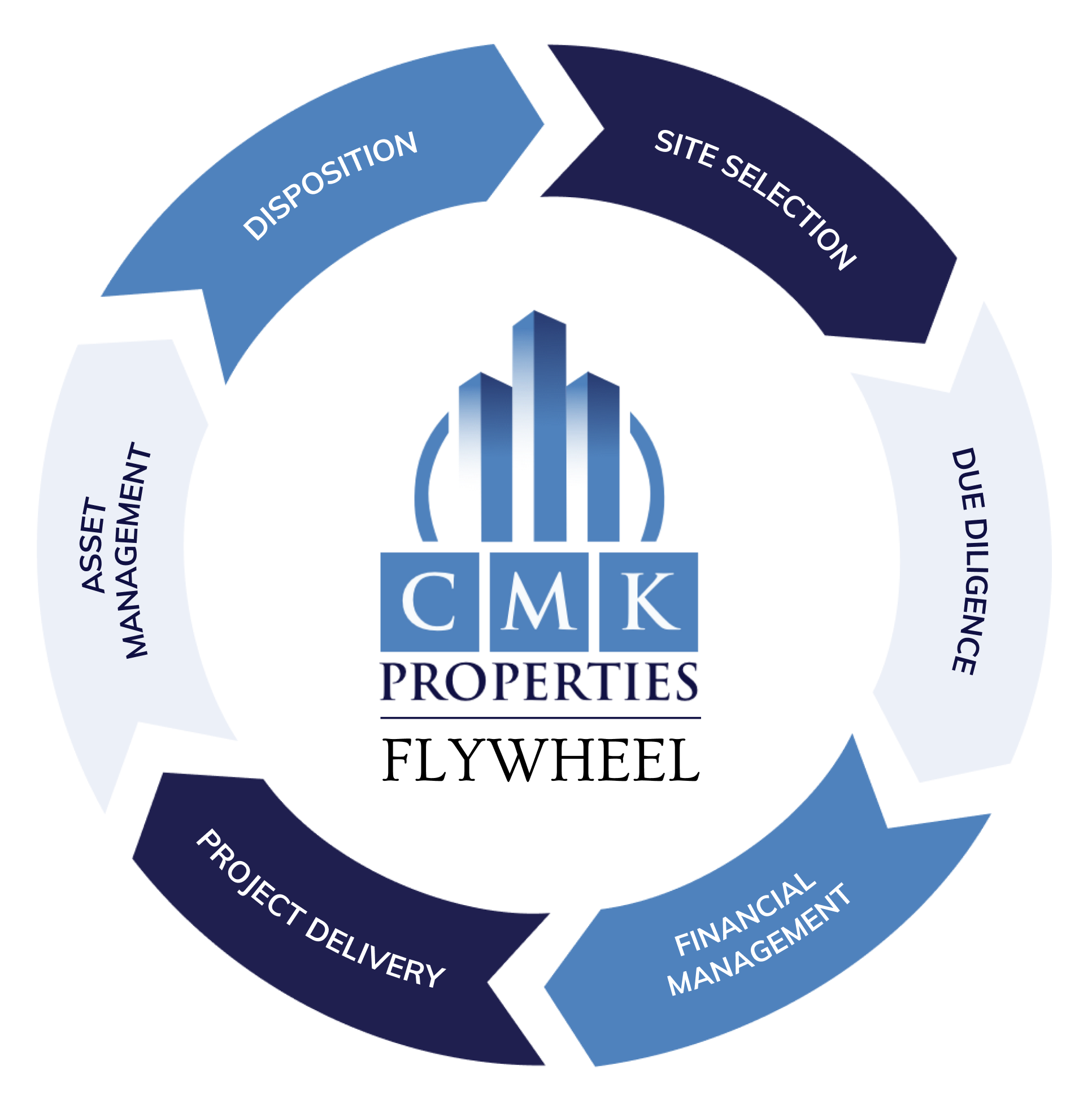
Each stage informs the next, while the experience gained from completed projects carries forward into future developments. Rather than treating each new location as an isolated transaction, our goal is to create a repeatable process that supports tenants as their real estate needs evolve and their footprints grow.
Partnering with CMK Properties
With more than 700 STNL development projects delivered collectively by our team, CMK brings extensive experience to both individual developments and broader multi-location expansion strategies. From identifying and evaluating new markets to managing site selection, due diligence, entitlements, construction, and delivery, we work to provide our tenant partners with a consistent development platform as they grow.
If your brand is planning its next location or evaluating a multi-market rollout, contact CMK Properties to learn how our build-to-suit platform can support your expansion strategy.
Key Takeaways
- Build-to-suit development can provide a repeatable framework for brands opening multiple locations.
- Consistent site criteria help tenants evaluate opportunities across different markets using the same standards.
- Developer-funded real estate can help preserve tenant capital for hiring, equipment, marketing, and other expansion priorities.
- An experienced development partner can reduce the internal burden of managing site selection, entitlements, permitting, construction, and delivery.
- A long-term development relationship can become more efficient as the developer gains familiarity with the tenant’s prototype and expansion strategy.
Frequently Asked Questions About Build-to-Suit Development
How does build-to-suit development work for a growing brand?
The tenant establishes its market, site, facility, and operational requirements, while the developer identifies potential locations and manages the development process. Once a site is approved, the developer typically oversees due diligence, entitlements, permitting, design coordination, construction, and delivery of the completed facility.
Does a tenant have to own the real estate in a build-to-suit development?
No. In many build-to-suit structures, the developer owns the property and leases the completed facility to the tenant under a long-term agreement. This allows the tenant to occupy a facility designed around its needs without purchasing and developing the real estate directly.
Can the same prototype be used across multiple locations?
Yes. One of the advantages of build-to-suit development is the ability to replicate an established prototype across markets. Adjustments may be required based on site conditions, local regulations, or market-specific needs, but the core facility design and brand standards can remain consistent.
Can one build-to-suit developer support expansion across multiple markets?
Yes. For brands planning a multi-location rollout, working with the same development partner across several markets can create greater consistency in site evaluation, project management, communication, and facility delivery.
How are locations selected for a multi-site rollout?
Potential sites are typically evaluated against the tenant’s established criteria, including demographics, market demand, competition, existing locations, traffic, access, zoning, infrastructure, site economics, and development feasibility. This helps determine how each location fits within the brand’s broader expansion strategy.
