March 23, 2026
From Groundbreaking to Grand Opening: The Lifecycle of a Single-Tenant Development
Published in
Insights
•
3
minute read
Share this Post:
Share this Case Study:
Opportunity
Services Provided
Results
In single-tenant real estate development, the strongest projects are the result of a disciplined process that begins long before construction starts and continues well after a building opens its doors. At CMK Properties, we approach development as a repeatable lifecycle rather than a one-time transaction. Each project moves through a series of interconnected stages designed to reduce risk, support tenant performance, and create long-term value for investors.
Here’s a look at the lifecycle behind a typical single-tenant net lease (STNL) development.
What Is the Lifecycle of a Single-Tenant Development?
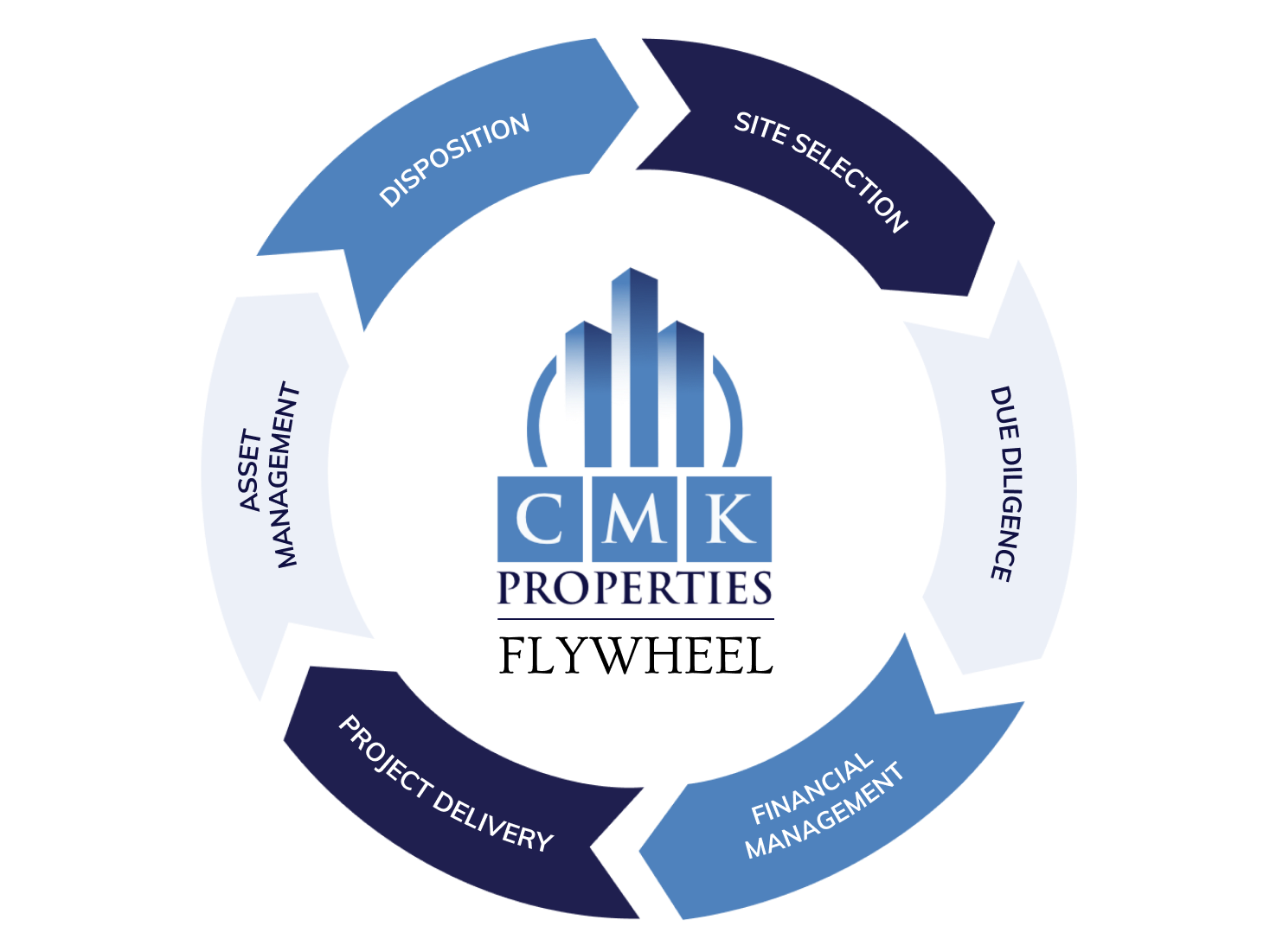
At CMK Properties, we view this lifecycle as a continuous, repeatable process rather than a linear progression. Our internal development flywheel moves through each stage of a project:
Site Selection → Due Diligence → Financial Management → Project Delivery → Asset Management → Disposition
Each phase plays a distinct role in moving a development from concept to completion. Once complete, the process begins again, allowing insights from one project to inform the next. This approach enables us to operate with consistency, refine our execution over time, and deliver more predictable outcomes for both tenants and investors.
Below is a closer look at the six stages that define our development process.
1. Site Selection: Identifying the Right Market Opportunity
Every successful project begins with the right location.
Site selection involves working closely with tenants to identify markets and parcels that support long-term operational success. This process combines market data, demographic analysis, and local market knowledge to ensure a location aligns with the tenant’s customer base and brand standards.
Key factors we evaluate include:
- Population growth and household income
- Traffic counts and visibility
- Accessibility and site layout
- Co-tenancy and surrounding retail environment
- Long-term market stability
A strong site creates the foundation for both tenant performance and long-term asset value, which is why this step receives significant attention before a project moves forward.
2. Due Diligence: Removing Uncertainty Early
Once a site is identified, the next step is comprehensive due diligence.
This stage focuses on confirming that the project is viable from legal, financial, and operational perspectives. Our team evaluates zoning requirements, environmental conditions, site constraints, and entitlement pathways to ensure the project can move forward smoothly.
Addressing potential challenges early helps avoid costly surprises later in the development process and keeps projects on schedule.
3. Financial Management: Structuring for Long-Term Value
With site feasibility confirmed, CMK next structures the financial framework that supports the development.
Because our projects are typically 100% pre-leased under long-term triple-net (NNN) agreements, investors gain clarity around projected income before construction begins. This structure also helps attract favorable financing terms and supports disciplined capital deployment.
For tenants, this phase ensures that lease terms and development timelines align with their broader expansion strategy.
4. Project Delivery: From Construction to Completion
With planning complete, the project moves into construction and delivery.
During this phase, CMK oversees contractor coordination, construction management, and schedule execution. Our goal is simple: deliver a high-quality facility on time and on budget. This stage culminates in the exciting moment when a project transitions from groundbreaking to grand opening.
Because many of our projects at CMK follow prototypical designs and repeatable construction approaches, the delivery process becomes more efficient over time, reducing variability across locations.
5. Asset Management: Supporting Long-Term Performance
The development lifecycle doesn’t end once the building is complete.
After delivery, CMK continues to manage the asset to ensure it performs as intended over the life of the lease. This includes monitoring tenant performance, maintaining relationships with stakeholders, and ensuring the property remains positioned for long-term stability.
For investors, this stage helps preserve asset value and income predictability until the property is ultimately sold.
6. Disposition: Realizing Long-Term Value
At the appropriate time, the asset may be sold to another investor or entity.
Because single-tenant net lease properties are widely sought after by private buyers, institutions, and REITs, well-structured assets often enjoy strong liquidity and multiple exit pathways. By the time a property reaches this stage, it has typically matured into a stabilized, income-producing investment backed by a long-term tenant lease.
For a look at how this lifecycle comes together in practice, we invite you to review a recent case study highlighting a completed development from initial site selection through disposition.
A Development Partner for the Full Lifecycle
At CMK Properties, our mission is to be the premier single-tenant net lease developer for the nation’s leading brands.
For tenants, that means partnering with a developer who understands how to move projects from concept to opening day with clarity and efficiency. For investors, it means working with a team that approaches development as a disciplined lifecycle designed to generate stable, long-term value.
If you’re interested in learning more about CMK’s single-tenant development strategy or partnering on a future project, contact our team today.
